Hotter Than a Hot Tub: The 45°C Breakthrough to Cool AI’s Biggest Machines
Original reporting by NVIDIA Blog
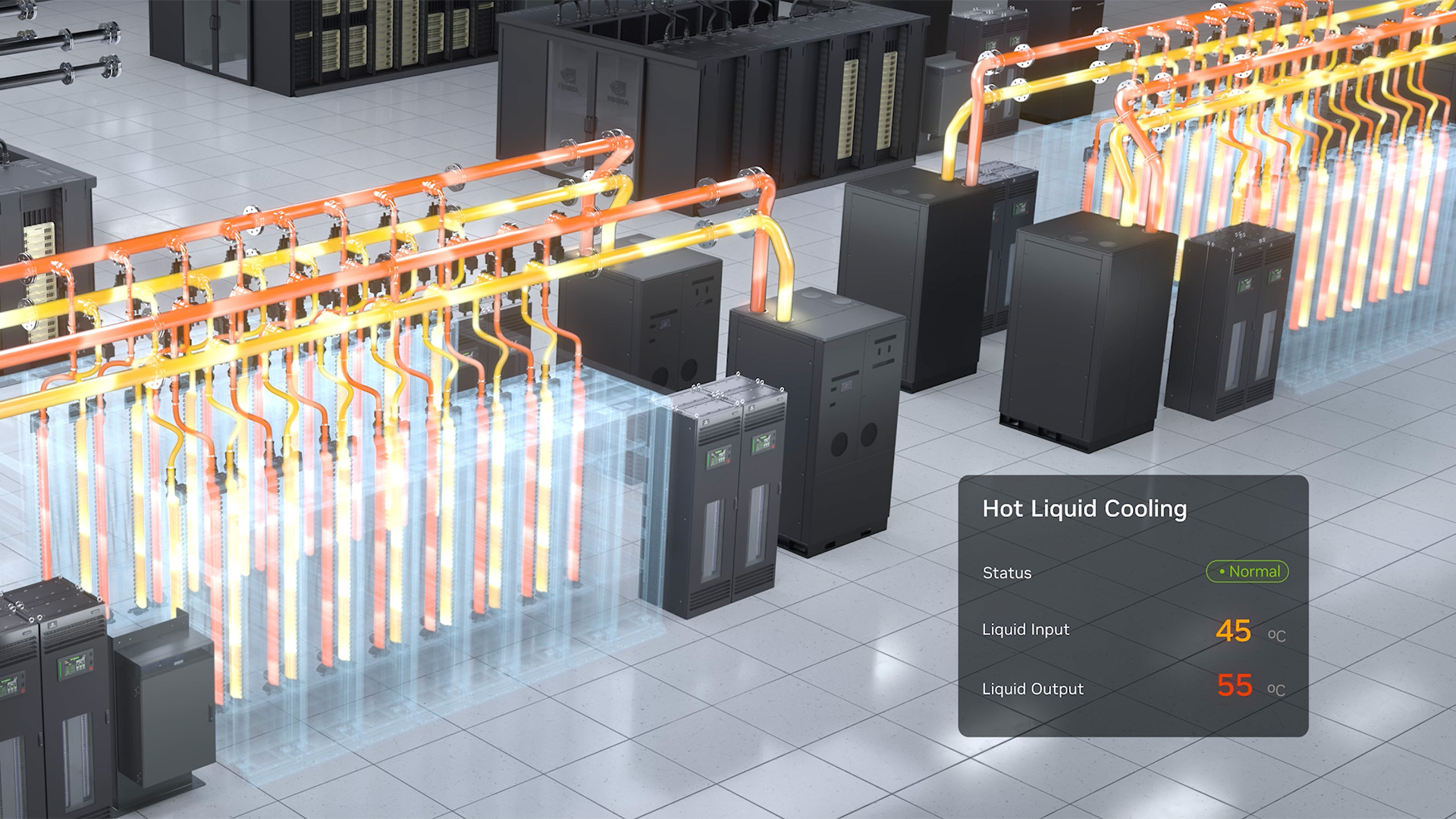
NVIDIA's Rubin generation AI infrastructure refers to its latest server design, distinguished by a revolutionary 100% liquid cooling system that operates at temperatures up to 45 degrees Celsius. This seemingly counter-intuitive approach—cooling with liquid warmer than a hot tub—is precisely what makes these new AI factories dramatically more energy and water efficient. Historically, cooling has accounted for up to 40% of a data center's electricity. By capturing heat directly at the chip with a closed-loop system, NVIDIA's design eliminates fans, reduces noise, and allows heat to be rejected efficiently by outdoor dry coolers for much of the year.
A New Efficiency Paradigm
This innovative methodology, outlined in the NVIDIA DSX AI factory reference design, slashes facility water consumption from millions of gallons annually to near zero in favorable climates. Raising chiller plant temperatures by just one degree can cut cooling energy costs by approximately 4%, compounding into millions of dollars in savings for hyperscale facilities. As AI workloads demand ever-increasing compute power, the industry faces a critical challenge: how to scale without skyrocketing energy and water demands. NVIDIA's 45-degree liquid cooling architecture provides a vital solution, enabling denser compute, quieter operations, and a sustainable path forward for the burgeoning AI industry.
NVIDIA's Rubin platform marks a pivotal moment in data center infrastructure. By achieving 100% liquid cooling for its AI servers, operating efficiently at temperatures up to 45 degrees Celsius, the company has fundamentally redefined how high-performance compute is managed. This innovation directly addresses the escalating energy and water demands of AI factories, slashing cooling-related electricity consumption by a significant margin and virtually eliminating water usage in many environments. Beyond substantial operational cost savings — potentially millions annually for hyperscale facilities — this higher-temperature liquid cooling enables greater power density within racks, reduces operational noise, and challenges long-held industry assumptions about optimal data center environments. It's a testament to engineering that tackles a critical bottleneck for AI's relentless growth and ensures its continued scalability.
Shaping AI's Future This technological leap is not merely an incremental upgrade; it represents a new, mandatory standard for the entire industry. As AI workloads continue their exponential expansion, fueled by increasing computational complexity, the ability to cool these systems efficiently and sustainably becomes paramount. NVIDIA's DSX AI factory reference design, centered on this advanced liquid cooling, effectively compels cloud providers and data center operators globally to adopt similar methodologies, recognizing that traditional air-cooling approaches are no longer viable for modern AI power densities. This paradigm shift paves the way for a future where massive AI compute demands can be met without prohibitive environmental footprints or spiraling operational costs, thereby supporting the broader digital transformation. Moreover, the higher operating temperatures inherent to this system unlock unprecedented avenues for waste heat recovery, positioning AI factories as potential contributors to local heating grids and fostering a more integrated, sustainable digital infrastructure. This commitment to efficiency is essential for AI to realize its full potential responsibly.
Frequently asked questions
- Why is NVIDIA's new liquid cooling more energy-efficient for AI data centers?
- NVIDIA's liquid cooling operates at a higher temperature, up to 45 degrees Celsius, allowing heat to be rejected more efficiently using outdoor dry coolers. This reduces reliance on energy-intensive mechanical chillers, which traditionally consume a significant portion of data center electricity. The closed-loop system also minimizes or eliminates water usage and fan requirements, leading to substantial overall energy and cost savings for hyperscale AI facilities.
- How does 100% liquid cooling impact data center design and operation?
- Fully liquid-cooled AI infrastructure eliminates the need for noisy fans and complex hot and cold aisles. It enables higher rack density, allowing more computing power in less physical space. Data centers can operate in warmer ambient conditions, significantly reducing mechanical cooling requirements and facility water consumption. This creates a fundamentally more efficient, quieter, and potentially chiller-less environment for advanced AI operations.
- What are the main environmental benefits of advanced liquid cooling in AI infrastructure?
- Advanced liquid cooling significantly reduces both energy and water consumption in data centers. By operating at higher temperatures, it dramatically cuts cooling energy usage, which traditionally accounts for a large portion of a data center's electricity. In favorable climates, it enables near-zero water consumption by eliminating evaporative cooling towers. This approach also allows for potential waste heat recovery, contributing to a more sustainable and environmentally friendly AI infrastructure.